
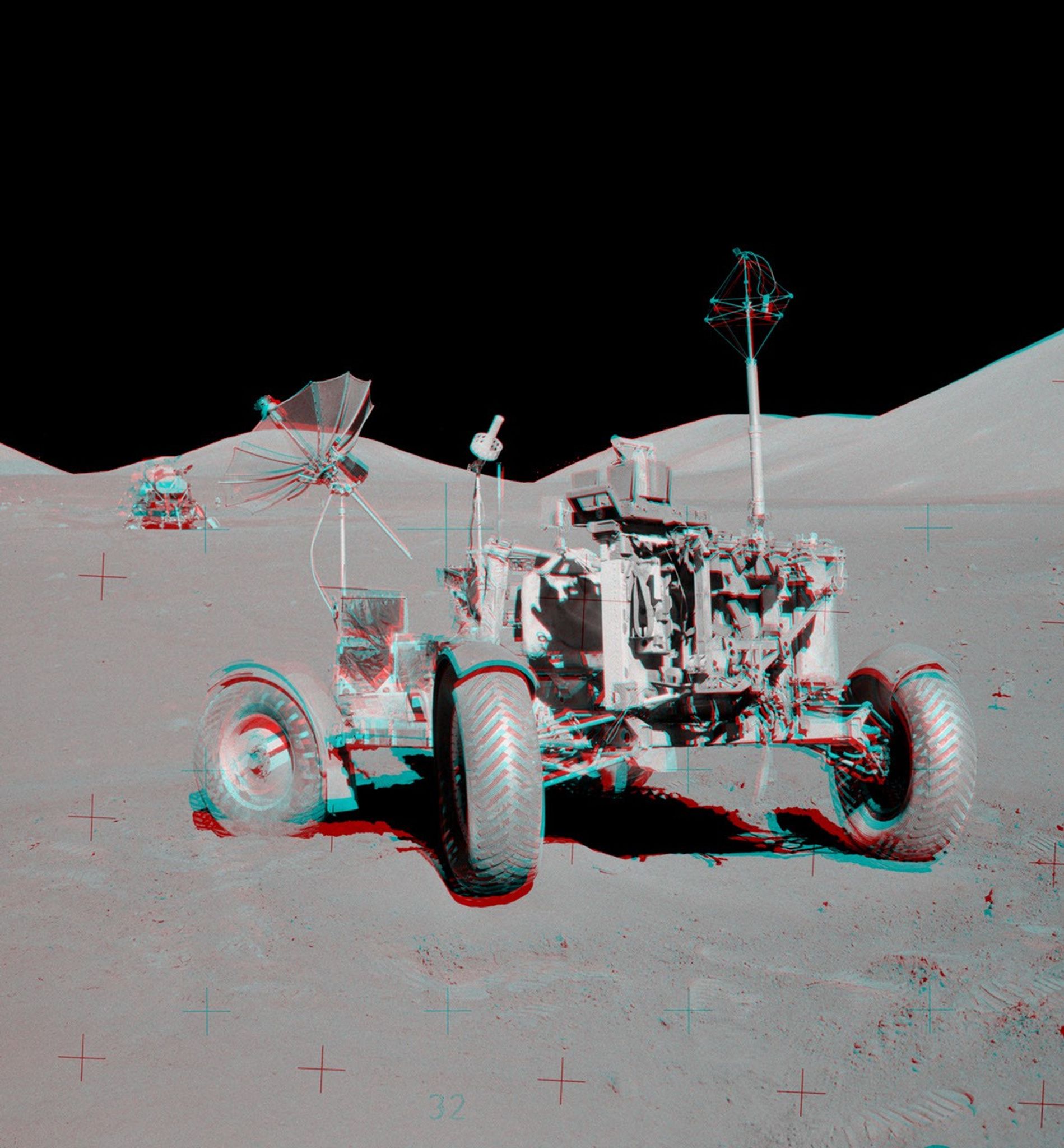
Image Credit: NASA
Reliving Humanity's Final Apollo Footsteps in Vivid 3D
Over five decades ago, humanity embarked on its last crewed lunar landing during the historic Apollo 17 mission in December 1972. While black-and-white broadcasts and static photographs documented this triumph, modern image processing has unlocked a breathtaking new dimension. Through a newly rendered stereo anaglyph, skywatchers and space enthusiasts can now step onto the lunar surface in stunning three dimensions.
What Was the Apollo 17 "VIP Site"?
The term "VIP Site" refers to a meticulously planned vantage point on the Taurus-Littrow valley floor. Before mission commander Eugene Cernan and lunar module pilot Harrison Schmitt prepared to leave the Moon, Cernan drove the Lunar Roving Vehicle (LRV) roughly 100 meters away from the Lunar Module Challenger.
This location was affectionately dubbed the VIP site because the rover's remotely operated color television camera was parked there to give Earth a front-row seat to the dramatic liftoff of the Ascent Stage. From this unique spot, ground controllers in Houston captured the unforgettable moment the spacecraft ignited its engine, propelling the astronauts back toward the orbiting Command Module America.
How Stereo Anaglyphs Bring the Moon to Life
Lunar photography often struggles to convey true scale because the Moon lacks atmospheric haze and familiar terrestrial landmarks like trees or buildings. This is where stereo anaglyphs excel:
- Two Perspectives: Astronauts captured images from slightly shifted positions, mimicking the inter-pupillary distance of human eyes.
- Depth Perception: When viewed through classic red-and-blue (cyan) glasses, the brain merges the paired images into a realistic, three-dimensional scene.
- Taurus-Littrow Topography: The anaglyph reveals the dramatic rise of the North and South Massifs, the scattering of rugged lunar boulders, and the fine dust churned up by the rover's mesh wheels.
A Bridge Between Apollo and Artemis
Revisiting the Apollo 17 landing site through modern visualization techniques is more than just an exercise in nostalgia. As NASA prepares to return astronauts to the lunar surface under the ambitious Artemis program, studying these historic exploration zones provides valuable operational context.
From analyzing the mechanical performance of lunar rovers in jagged regolith to understanding how lighting angles affect human depth perception, Apollo 17 remains a vital classroom for future lunar pioneers. Pull out your 3D glasses, peer into the valley of Taurus-Littrow, and experience the Moon just as our last lunar explorers saw it.
---
This email was sent automatically with n8n






0 Comments